
by Leah Geer and Razi Zarchy
This blog is based on a monograph: Zarchy, R.M. & Geer, L.C. (2023). A Family-Centred Signed Language Curriculum to Support Deaf Children’s Language Acquisition. Cambridge University Press.
International Sign
American Sign Language
Theoreticians out there, are you looking for ways to make a more direct impact on your work? If so, this blog is for you!
I’m sure you know the oft-cited statistic that only 5-10% of deaf children are born to deaf parents and according to the Office of Research Support and International Affairs at Gallaudet University, only 20% of hearing families regularly sign with their deaf children. There are many reasons for this unfortunate situation. One reason is that most materials available for families to learn a signed language are focused on pre-service learners like those studying to become teachers of the deaf or interpreters. But families of deaf children have different needs than pre-service learners, making these curricula inadequate and unhelpful. To address this need, we developed a family-centered curriculum for ASL and encourage scholars around the world to develop similar curricula for their respective signed languages.
If you’ve done mostly theoretical work up to this point but are interested in developing a more applied focus, 1) you’re more than qualified to do this and 2) we’ve got six tips for how to go about developing a family-friendly curriculum.
- Choose common daily routines in the lives of young children. If you’re not a practitioner, collaborate with teachers of the deaf, signed language specialists, signing speech-language pathologists, early interventionists, and others to determine which daily routines will be the most useful in your area.
- Determine frequently used core vocabulary related to each routine. Core vocabulary includes words that can be used in any environment or situation and comes from all word classes including pronouns, verbs, modifiers, prepositions, determiners, conjunctions, interjections, question words, and nouns. Importantly for building sentences, you don’t want to include long lists of nouns because that does not facilitate sentence-building.
- Develop simple sentences containing the core vocabulary, building cumulatively. The goal of a family curriculum should be to have many small wins to build confidence in learning this new language. The best way (in our experience) to do this, is to encourage as much “hands up” time as possible. Learners should be signing along with videos and/or with live instructors. A signed language can’t be learned passively!
- Teach evidence-based facilitative language techniques in family-friendly language. Facilitative language techniques are used by speech-language pathologists/therapists and teachers of the deaf to encourage linguistic development. They have been shown to accelerate language acquisition. In addition, studies of deaf mothers have identified visual tactile techniques to increase the visibility of signs in the child’s environment. Techniques should start quite simply and build in level of difficulty/complexity.
- Incorporate Deaf Community Cultural Wealth lessons. These lessons can be discussion-based and start by teaching each type of cultural wealth (Yosso, 2005) by encouraging introspection about how learners’ own cultural wealth, then progress by relating each type of cultural capital to deaf culture (Geer & Zarchy, 2023).
- Make the curriculum available to service providers and families. There is a dearth of resources for families already. Once developed, even if it hasn’t been thoroughly tested, make the curriculum available. Seek and incorporate feedback from early adopters to guide subsequent editions of the curriculum.
The two key things to remember in developing a family-centered curriculum and related to the tips shared above are:
- Collaboration is key! You don’t need to have all the expertise to write a curriculum. Lean on other professionals, especially those with extensive direct service experience.
- Seek and incorporate feedback from stakeholders. This should include providers, families, and of course, deaf community members.
While some professionals argue that signed languages are too difficult for hearing parents to learn; we disagree. Language learning in adulthood is challenging, but it’s achievable especially with the right structure and support.
References
Geer, L. C., & Zarchy, R. M. (2023). The importance of teaching Deaf Community Cultural Wealth in family-centered sign language curricula. Diffractions, 2(7), 82–107. https://doi.org/10.34632/diffractions.2023.12002
Yosso, T. J. (2005). Whose culture has capital? A critical race theory discussion of community cultural wealth. Race Ethnicity and Education, 8(1), 69–91. https://doi.org/10.1080/1361332052000341006
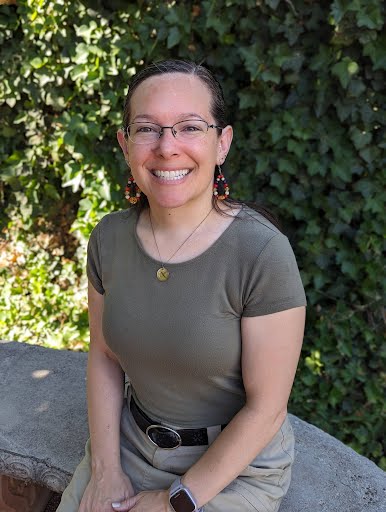
Leah is an Associate Professor and Program Coordinator of the ASL and Deaf Studies program at California State University, Sacramento. She earned her PhD in Linguistics from The University of Texas at Austin, completed a Graduate Certificate from Gallaudet University in June 2023, and an MA in Early Intervention Studies in December 2024. She is the co-author of ASL at Home, a routine-based ASL curriculum for families with young deaf children and serves as a Commissioner for the Commission on Collegiate Interpreter Education (CCIE). She is also a Board Member of the American Board of Deaf and Hard of Hearing Specialists (ABDHHS).

Razi Zarchy, SLPD, CCC-SLP is a hearing, ASL-fluent speech-language pathologist who lives and works in California. His pronouns are he/him/his. He worked with deaf and hard of hearing children ages birth to 18 for 12 years, particularly in early intervention and preschool. He has a clinical doctorate in speech-language pathology (SLPD) from Rocky Mountain University of Health Professions and began a PhD program in Education and Leadership at Pacific University Oregon in Fall 2023. Razi is a co-author of ASL at Home, a family-centered ASL curriculum based on daily routines in the lives of young children and their families. He currently works as a lecturer and clinical instructor at California State University, Sacramento and an adjunct faculty member at Gallaudet University.
 Acadeafic